Research
Resilient power electronics systems - a cornerstone of future power systems.
Research Overview
Rapid growth in AI infrastructure, advanced manufacturing, electrified transportation systems, and increasingly diverse generation and energy-storage resources are reshaping how electrical energy is generated, transmitted, distributed, and consumed. These trends are driving unprecedented demand for flexible and reliable power conversion, making power electronics converters a critical enabling technology for future power systems. Yet the growing dependence on power electronics converters introduces a fundamental reliability challenge. Unlike conventional electromechanical systems, power electronics systems operate under strict semiconductor device constraints, increasingly modular hardware architectures, and deep dependence on sensing, communication, and digital control. Therefore, grid disturbances, component failures, and cyber anomalies can propagate rapidly across physical and cyber domains. A central scientific question is thus: How can future power electronics systems withstand diversified disturbances, maintain critical functionality, and autonomously recover from failures?
Research Interests
-
Current-Limiting Control of Grid-Forming Inverters: Grid-forming inverters play a critical role in supporting future power systems, but their limited overcurrent capabilities introduce significant challenges during grid disturbances. My research focuses on advanced control strategies that balance semiconductor protection, transient stability, and grid-support capabilities, enabling reliable operation under severe and dynamic grid conditions.
-
Stability and Resilience of Heterogeneous Converter Networks: Future power systems will increasingly integrate converters from different manufacturers, featuring diverse control architectures and dynamic characteristics. Limited access to proprietary converter information introduces significant challenges for system-level analysis and operation. My research aims to develop generalizable modeling and stability assessment frameworks that support reliable integration and resilient operation of heterogeneous converter-dominated networks.
-
Power System Black Start and Restoration with Inverter-Based Resources: The rapid response and distributed nature of inverter-based resources offer new opportunities to enhance power system resilience and accelerate recovery following major disturbances. My research explores advanced black-start and restoration strategies that leverage these capabilities to improve restoration efficiency, adaptability, and reliability under uncertain post-disturbance conditions.
-
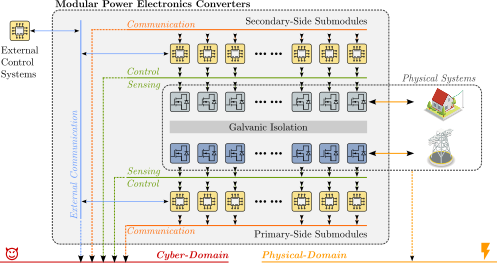
Decentralized Control of Modular Power Converters: Modular power converters are emerging as key enabling technologies for medium- and high-voltage applications, including renewable energy integration, electrified transportation, and data-center power infrastructure. My research focuses on decentralized control architectures that reduce reliance on centralized coordination and communication, enhancing the scalability, reliability, and fault tolerance of next-generation modular power conversion systems.
-
Solid-State Protection and Grid-Support Technologies: Advances in power semiconductor technologies are enabling new generations of solid-state protection devices for medium- and high-voltage AC/DC networks. Beyond ultrafast fault interruption, these devices offer opportunities for enhanced controllability and multifunctional grid support. My research investigates advanced protection and control methods to improve the safety, flexibility, and resilience of future power networks.
-
Multi-Domain Modeling of Cyber-Physical Power Electronics Systems: Modern power electronics systems rely heavily on interconnected sensing, communication, and digital control infrastructures, creating complex interactions between cyber and physical domains. My research focuses on integrated modeling and analysis frameworks that capture these interactions and their responses to faults, failures, and cyber anomalies, supporting more secure and resilient power electronics systems.
-
Physics-Guided Data-Driven Condition Monitoring: The increasing complexity and diversity of modern power electronics systems challenge traditional model-based monitoring and diagnostic approaches, particularly when internal system information is limited. My research explores physics-guided data-driven methods that integrate available physical knowledge with measured operational data to enable reliable, interpretable, and adaptable condition monitoring and anomaly detection.